

By the fifth day in a daycare environment, the system becomes visible.
You learn the physical space.
You learn the rhythm of transitions.
You learn how time, not emotion, moves the day forward.
Names begin to settle, but routines settle faster.
And this becomes clear:
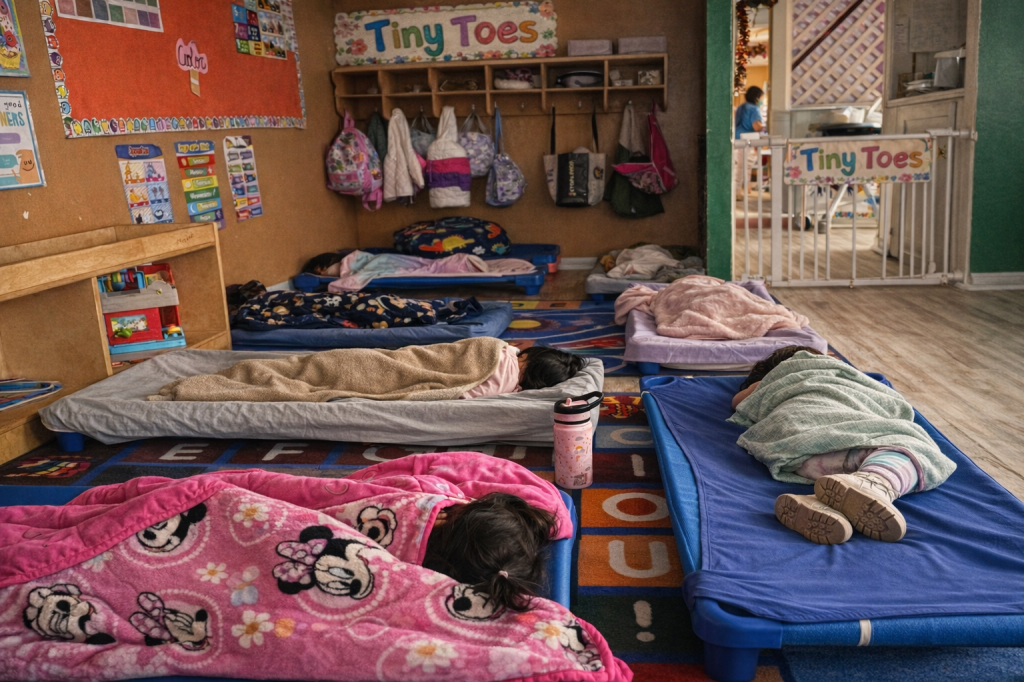
Daycare is not meant to function like a home.
It is meant to function like a system.
Daycare as a Community Environment
Early childhood settings are collective spaces.
They are designed for groups, not individuals.
Because of this, daycare cannot operate on negotiation or personal preference.
It operates on shared structure.
For toddlers and preschool-aged children, the most critical developmental need is not freedom, but predictability.
Bathroom routines Hand hygiene Meals Rest Waiting Lining up Cleaning up
These are not secondary tasks.
They are core developmental work.
Daycare exists to organize these rhythms in a consistent, repeatable way.
Reframing Discipline
In early childhood education, discipline is often misunderstood.
Discipline in daycare is not punishment.
It is consistency applied at scale.
Rules are not flexible based on mood or circumstance.
They do not change depending on class size.
One rule applies to:
one child
ten children
one hundred children
A rule is defined by time and sequence, not by individual readiness.
When it is time to eat, play ends.
When it is time to rest, bodies slow down.
When it is time to clean up, everyone participates.
This is not harshness.
This is environmental stability.
And stability is regulating for young children.
Appropriate Firmness in Early Childhood Settings
Yes, voices become firm at times.
Yes, choices are occasionally removed.
Yes, “no” is sometimes final.
This is developmentally appropriate.
Children at this age are learning:
bodily regulation personal care routines group behavior time-based transitions
These skills are not acquired through explanation alone.
They are learned through repetition, modeling, and clear limits.
Firmness in this context is not emotional distance —
it is clarity.
An Uncomfortable but Useful Comparison
There is a comparison educators often avoid:
Daycare can resemble training.
This comparison is uncomfortable because it sounds mechanical.
But training, in its true sense, is not dehumanizing.
Training is the process of moving from instinct to structure.
Children are not being controlled.
They are being prepared:
for school environments for shared public spaces for functioning within a community
Structure is not imposed to diminish children —
it is provided to support them.
Structure Enables Joy
One important truth often gets lost in these conversations:
Fun follows structure.
Once expectations are clear:
play becomes collaborative activities become accessible children feel safer exploring
Without structure, play escalates into chaos.
With structure, play becomes meaningful.
Daycare is not designed to entertain children.
It is designed to create the conditions in which joy can emerge.
A Reflection from Day 5
Being warm is easy.
Being kind is easy.
Running a daycare requires more than that.
It requires:
consistency clarity shared expectations a unified approach
Yes, this can feel strict.
But this kind of strictness does not harm — it reassures.
Children do not need constant choice.
They need reliable structure.
The rule is the rule.
The time is the time.
And once that foundation is in place —
children are free to enjoy themselves.
 Natali Stoiyanna Erkaraman
Leave a comment